
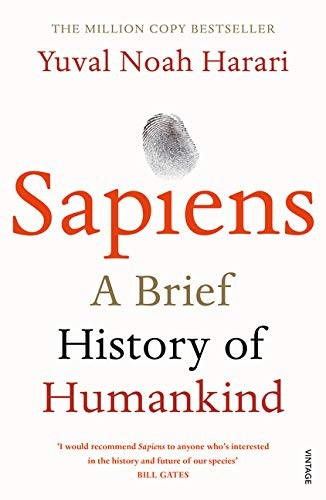
Summary preview
{ "title": "Sapiens: A Journey Through Human History", "introduction": { "summary": "Yuval Noah Harari's 'Sapiens: A Brief History of Humankind' offers a thought-provoking exploration of human history, moving beyond traditional narratives to focus on the unique ability of Homo sapiens to create and believe in shared stories or 'fictions.' This capacity for collective imagination, Harari argues, is the key to our species' dominance and the foundation of complex societies, economies, and cultures. The book structures this journey around three major revolutions: the Cognitive, Agricultural, and Scientific.", "keyidea": "The power of shared fictions (imagined realities) is the defining characteristic of Homo sapiens, enabling large-scale cooperation." }, "sections": [ { "title": "The Cognitive Revolution: When Stories Took Over", "content": "Around 70,000 years ago, a shift in Homo sapiens' brain wiring led to the development of flexible language. This enabled abstract thought, the creation of myths, legends, and gods, and the ability to discuss things not physically present. Harari posits that early language likely evolved for 'gossip,' facilitating complex social relationships within groups. This ability to believe in shared, imagined realities allowed Sapiens to cooperate in unprecedented numbers, outcompeting other human species and spreading across the globe. This revolution laid the groundwork for rapid cultural evolution, where learned behaviors and ideas could spread much faster than biological evolution.", "keypoints": [ "Genetic mutation altered brain wiring, not size.", "Development of flexible, abstract language.", "Ability to create and believe in shared myths and imagined realities.", "Facilitated large-scale cooperation beyond Dunbar's number.", "Enabled outcompetition of other human species.", "Foundation for rapid cultural evolution." ] }, { "title": "The Agricultural Revolution: The Farmer's Burden?", "content": "Beginning around 12,000 years ago, the shift from foraging to settled agriculture is controversially labeled 'history's biggest fraud' by Harari. While it allowed for a massive population boom due to increased calorie production per land unit, it often led to harder work, poorer and less varied diets, increased disease due to denser populations and proximity to animals, and greater social inequality for the average individual compared to their hunter-gatherer ancestors. Harari argues it was a 'trap' – once adopted, there was no going back, creating a relentless pressure for more farming, more children, and more difficult lives, benefiting the species' numbers but not necessarily individual well-being.", "keypoints": [ "Shift from foraging to settled farming.", "Called 'history's biggest fraud' due to individual hardship.", "Led to harder labor, poorer nutrition, and increased disease.", "Enabled population explosion, not necessarily individual improvement.", "Created a 'trap' making return to foraging difficult.", "Paved