
Summary preview
Unlocking the Universe with Equilibrium Statistical Physics: A Friendly Deep Dive
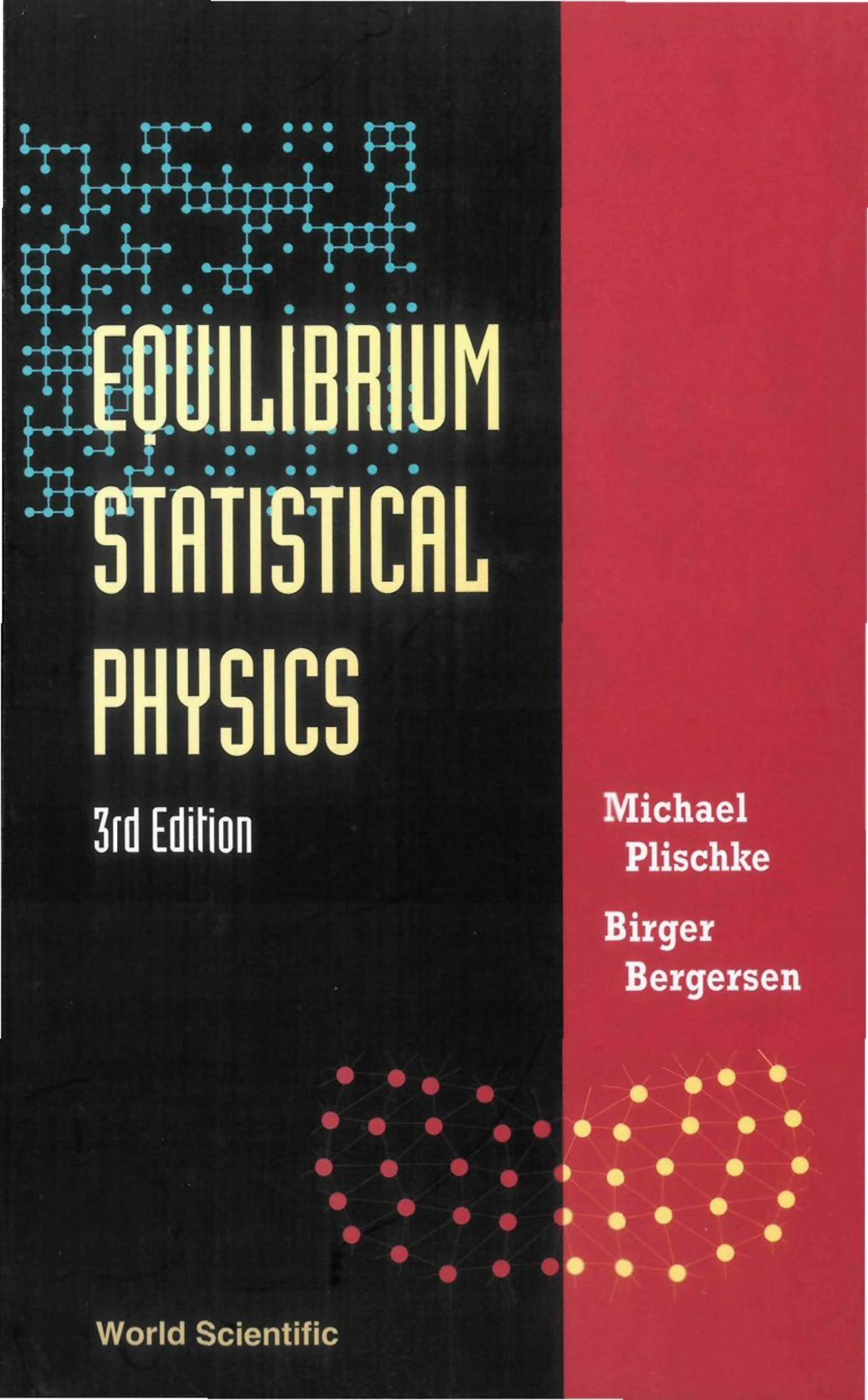
This summary distills the core concepts of Plischke and Bergersen's "Equilibrium Statistical Physics," exploring how the microscopic world of particles dictates the macroscopic phenomena we observe. It emphasizes the power of statistical methods to understand systems in stable states, connecting fundamental physics to everyday observations and practical applications.
Section 1: Introduction - The Big Picture from the Small Stuff
Equilibrium statistical physics acts as a bridge between the microscopic laws governing individual particles (quantum and classical mechanics) and the macroscopic laws of thermodynamics describing bulk properties like temperature and pressure. Since tracking trillions of particles is impossible, statistical physics uses probabilities and averages to predict observable properties. The "equilibrium" aspect focuses on systems that have reached a stable, unchanging state, simplifying analysis. The book's goal is to provide a foundation for understanding how macroscopic properties emerge from the collective statistical behavior of microscopic constituents in these stable conditions.
Section 2: Main Theses - The Pillars of the Theory
The book is built on four core ideas: 1. Microscopic Governs Macroscopic (via Statistics): Macroscopic properties are a consequence of the collective behavior of atoms and molecules, understood through statistical methods and probabilities. 2. The Canonical Ensemble is Key: For systems in thermal equilibrium with a heat bath (constant temperature, volume, particle number), the canonical ensemble is crucial. Its partition function (Z) encapsulates all thermodynamic information. 3. Phase Transitions are Emergent: Dramatic changes in matter (like boiling or freezing) are collective phenomena arising from particle interactions, understood through concepts like order parameters and critical phenomena. 4. Fluctuations are Informative: Random deviations from average values are inherent and provide valuable insights into system stability and